
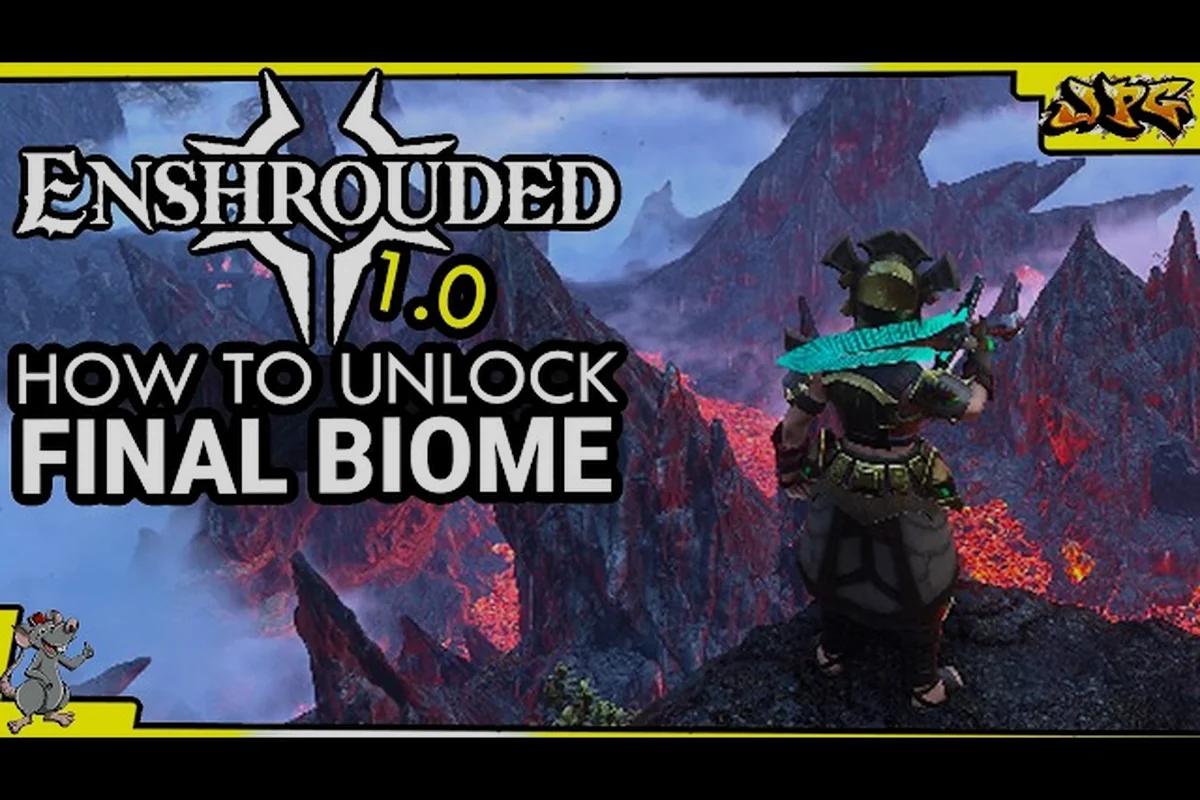
The Enshrouded Cinder's Cradle update is the biggest map expansion Embervale has seen, and it finally pushes the level cap past its old ceiling. This northern biome sits beyond the Veilwater Basin, adds 12 new Shroud Roots, and rewrites how you plan Shroud time. Here's what changed and how to prepare.
What the Cinder's Cradle Update Adds to Embervale
The headline of this Enshrouded new biome update is simple: the full map is now accessible, and Cinder's Cradle fills the northern regions past the Veilwater Basin. According to the the official Enshrouded Steam news archive, the biome sits between Blackmire and Veilwater Basin in overall size, which makes it a mid-sized region rather than a sprawling endgame zone. That scale matters, because it means you can clear it without committing dozens of hours to a single area.
Cinder's Cradle is built in two stacked layers. The lower level is a lava wasteland of ruins, choked with heat hazards and crumbling Flameborn architecture. The upper level is a realm of floating islands, connected by tendrils of the Shroud that act as vertical pathways. You move between them using the same traversal kit you already know — the grappling hook and glider — but the verticality forces you to think about stamina and fall damage far more than in the Low Meadows.
The most consequential addition is the 12 new Shroud Roots. Each one anchors a patch of Shroud fog to the terrain, and clearing a Root permanently thins the fog in that area. If you've ever fought the Shroud timer and lost, this is the mechanic that finally gives you breathing room. The the community wiki for Enshrouded documents Shroud Roots as a core 1.0 system, though its numbers are community estimates and may lag behind the live build.
Here's the quick breakdown of what the update delivers: the biome is split into a lava wasteland of ruins below and a realm of floating islands above, with 12 new Shroud Roots to cleanse, a raised level cap for deeper skill tree investment, the Sparkworks logic system for base automation, and new Shroud-tendril traversal routes linking the two vertical layers — which is why this Enshrouded new biome update reshapes both exploration and base-building at once.
-
A two-tier biome: lava ruins below, floating islands above
-
12 new Shroud Roots to locate and cleanse
-
A raised level cap that unlocks deeper skill tree investment
-
The Sparkworks logic system for base automation
-
New Shroud-tendril traversal routes between vertical layers
The biome also changes how you read the map. Because the two layers overlap in the same coordinate space, a marker on your compass may point to a floating island directly above a lava ruin you're standing in. Players report getting turned around here more than anywhere else in Embervale, so treat vertical position as a separate navigation axis.
Why the Two-Layer Design Changes Exploration
Most Embervale biomes are horizontal — you walk from A to B and the terrain is roughly at one elevation. Cinder's Cradle breaks that pattern deliberately. The lava wasteland below is dense with ruins that hide chests and crafting materials, while the floating islands above hold the Shroud tendrils that let you cross gaps you can't glide over.
The practical consequence is that a single "area" in Cinder's Cradle can contain two completely different loot tables. A ruin below might drop heat-resistant gear, while the island directly overhead drops something else entirely. If you're hunting a specific material, check both layers before moving on. This is also why the biome feels larger than its footprint suggests — you're effectively exploring two maps stacked on one another.
The Enshrouded Max Level Increase and What It Unlocks
The Enshrouded max level increase is the change most veteran players were waiting for. A higher cap means more Skill Points, and more Skill Points means you can finally finish a build instead of spreading points thin across three trees. The official store page describes a deep skill tree split across juggernaut, ranger, and battlemage archetypes, and the new cap lets you push one archetype to its natural end while still dipping into a second for utility.
The table below shows how the raised cap reshapes build planning compared to the old ceiling: at the previous level limit, a battlemage who wanted both the top-tier fire node and a defensive stamina buffer had to sacrifice one entirely, because the point pool ran dry around the third tier of a second tree. With the Enshrouded max level increase, that same character can now finish the primary damage path and still afford roughly a dozen utility points for survivability — which is exactly what the lava layer in Cinder's Cradle demands when your stamina bar is the only thing keeping you off the floor.
| Build Goal | Before the Cap Increase | After the Cap Increase |
|---|---|---|
| Single-archetype mastery | Often incomplete | Fully reachable |
| Hybrid (two trees) | Very tight | Comfortable |
| Triple-dip utility | Not viable | Possible with sacrifice |
| Capstone skills | Usually skipped | Realistic target |
| Respec pressure | High | Much lower |
The key takeaway is that hybrid builds are now the sweet spot. You no longer have to choose between a fully realized battlemage and a survivable melee frame — you can cap one tree and spend the remainder on defensive or mobility nodes. That flexibility matters enormously in Cinder's Cradle, where the lava layer punishes slow movement and the floating layer punishes low stamina.
If you're rebuilding from scratch, the max health guide explains how to layer survivability nodes on top of your damage investment so the extra points actually translate into staying alive. Health scaling and Skill Point efficiency are tightly linked, and wasting the new cap on redundant nodes is the most common mistake right now.
Which Skill Trees Benefit Most
Not every tree gains equally from the extra points. The battlemage tree benefits most because its late nodes compound — each point spent on spell damage makes the next one worth more. The ranger tree benefits second-most, since its mobility and stamina nodes directly counter Cinder's Cradle's vertical hazards.
The juggernaut tree gains the least in raw power, but it gains the most in convenience. Its defensive capstones let you ignore heat and fall damage thresholds that would otherwise force constant retreats. If you play solo, a juggernaut base with battlemage splash is arguably the safest way to explore the new biome without dying to environmental damage every ten minutes.
Enshrouded Sparkworks Update: Automation Comes to Your Base
The Enshrouded Sparkworks update introduces a logic system that turns your base from a static camp into a working machine. According to the the Enshrouded news page, Sparkworks is filed under major updates alongside the 1.0 launch and combat overhaul, which signals it's a foundational system rather than a cosmetic add-on.
Sparkworks lets you wire triggers to outputs. A trigger might be a pressure plate, a lever, or a sensor; an output might be a door, a light, or a crafting station. Chain them together and you get simple automation — a gate that opens when you step on a plate, or lights that switch on when night falls. It's not a full programming language, but it's enough to remove a lot of repetitive clicking.
The table below maps the core Sparkworks components to their practical uses, and reading it as a wiring blueprint rather than a glossary is the fastest way to plan a build. Each row pairs one trigger type with the output it suits best, so you can trace a signal path before placing a single node: a pressure plate for hands-free base gates, a lever for manual day/night lighting toggles, and a sensor for trap doors and hidden rooms where a state change — not a player's footstep — should fire the mechanism. The output node is the common endpoint every trigger eventually reaches, whether that is a door, a light, or a crafting station, while the logic gate is what lets two conditions combine into multi-condition security, such as a gate that only opens when a lever is thrown and a sensor is clear.
| Component | Function | Best Use Case |
|---|---|---|
| Pressure plate | Trigger on contact | Auto-opening base gates |
| Lever | Manual toggle | Switching between day/night lighting |
| Sensor | Detects state change | Trap doors and hidden rooms |
| Output node | Receives signal | Doors, lights, stations |
| Logic gate | Combines signals | Multi-condition security |
For base builders, the biggest win is defensive automation. You can build a corridor where stepping on a plate closes a door behind you and opens one ahead, creating a one-way passage that keeps wandering enemies out. Combined with the raised level cap's extra points, a builder-focused character can now afford the utility nodes that make large automated bases practical.
How Sparkworks Interacts With the Flame Altar
Sparkworks doesn't replace the Flame Altar — it extends it. The Altar still defines your base boundary and respawn point, and the Flame Altar guide covers how upgrading it expands that boundary. What Sparkworks adds is behavior inside that boundary.
The practical implication is that a larger Altar radius now means more room for automated systems. If you've been holding off on Altar upgrades because your base felt "done," Sparkworks gives you a concrete reason to expand. More space means more trigger-output chains, and more chains mean a base that runs itself while you're out clearing Shroud Roots.
Enshrouded Back to the Shroud Update and the 12 New Roots
The Enshrouded back to the Shroud update is the thematic core of this patch. The Shroud has always been the game's central hazard — a thick fog covering parts of Embervale where you can only survive for a limited time before your character dies, per the Enshrouded Wikipedia entry. The new biome doubles down on that tension by scattering 12 Roots across both layers.
Each Root you cleanse permanently thins the fog around it. That's a meaningful shift from earlier biomes, where Shroud coverage was largely fixed. Now you can methodically reclaim territory, and the order you cleanse Roots in directly affects how easy the rest of the biome becomes.
The table below ranks the Roots by rough difficulty based on community reports, cross-referencing each tier's location layer against its threat level and the prep loadout that clears it comfortably. Note that difficulty is not fixed: because cleansing a Root permanently thins the Shroud around it, the same Upper Root on a floating island plays far easier once you've cleared the Early and Mid Roots in the lava ruins below. Treat the tiers as a routing order rather than a static ranking — the recommended prep column assumes you're tackling each tier with the fog already reduced by every preceding cleanse.
| Root Tier | Location Layer | Threat Level | Recommended Prep |
|---|---|---|---|
| Early Roots | Lava ruins, edges | Low | Basic heat resistance |
| Mid Roots | Lava ruins, center | Medium | Upgraded armor, healing |
| Upper Roots | Floating islands | High | Stamina nodes, glider skill |
| Final Roots | Shroud tendril hubs | Very high | Full build, co-op advised |
The Shroud tendril hubs are the toughest because they combine fog pressure with vertical combat. You're fighting on narrow floating platforms where a single knockback can send you into the lava below. Solo players should clear the lower-layer Roots first to thin the fog, then tackle the upper Roots with a shorter Shroud timer working against them.
Managing Shroud Time in the New Biome
Shroud time is a resource to plan around, not a hazard to ignore — that principle holds even more strongly in Cinder's Cradle. Because the biome has two layers, you can't simply run in a straight line to the nearest safe zone. You have to plan a route that touches a Root, exits the fog, and returns to solid ground before the timer expires.
A practical approach is to scout from above first. Glide over the lava ruins, mark Root locations on your map, then descend with a plan. This costs a few minutes upfront but saves multiple death runs. The Shroud Root guide breaks down the cleansing process step by step if you're new to the mechanic.
Enshrouded Update 8 Highlights and Major Updates History
The Enshrouded update 8 highlights sit at the end of a long chain of changes, and understanding that history helps you see where the game is heading. The Enshrouded's official news page organizes entries into categories like Patch Notes, Major updates, Hot fixes, and In-game Drops, which makes it easy to trace the arc from early access to the current 1.0 state.
The table below summarizes the major milestones that led to Cinder's Cradle: from the early access launch that established the Shroud timer, through biome expansions that added Blackmire and Kindlewastes, to the combat overhaul that reworked parry and dodge timing. The 1.0 launch opened all regions, and Cinder's Cradle followed as the northern biome introducing 12 Roots and raising the level cap, while the Sparkworks update layered in base automation — read the rows in order to see how each patch built on the last.
| Milestone | Focus | Lasting Impact |
|---|---|---|
| Early access launch | Core survival loop | Established Shroud timer |
| Biome expansions | Map growth | Added Blackmire, Kindlewastes |
| Combat overhaul | Fighting feel | Reworked parry and dodge |
| 1.0 launch | Full map access | Opened all regions |
| Cinder's Cradle | Northern biome | 12 Roots, level cap raise |
| Sparkworks | Base logic | Automation system |
The Hotfix 1.0.0.1 changelog dated 15 October 2026 also shipped alongside this content, addressing stability issues that surfaced after the 1.0 launch. If you're returning after a break, patching to the latest hotfix before exploring Cinder's Cradle is worth the few minutes it takes.
What the Update History Suggests About the Future
If the pattern holds, the next major update will likely pair another region with another system. The floating-island layer in Cinder's Cradle feels like a testbed for vertical design, and Sparkworks feels like a foundation for deeper base mechanics. Neither system is fully explored yet, which suggests the developers are building toward something larger.
For now, the practical advice is to invest in the new systems early. Skill Points spent on stamina and mobility pay off in the floating layer, and time spent learning Sparkworks pays off every time you expand your base. Players who treat Cinder's Cradle as just another map to clear will miss half of what this update actually offers.
Frequently Asked Questions
What is the Enshrouded Cinder's Cradle update?
It's the major 1.0-era content drop that opens the full map and adds Cinder's Cradle, a northern biome past the Veilwater Basin. The region has two layers — lava ruins below and floating islands above — plus 12 new Shroud Roots, a raised level cap, and the Sparkworks logic system for base automation.
How many Shroud Roots are in Cinder's Cradle?
There are 12 new Shroud Roots spread across both the lava wasteland and the floating islands. Cleansing each one permanently thins the Shroud fog around it, so the order you clear them in directly affects how difficult the rest of the biome feels. Community reports suggest the tendril-hub Roots are the hardest.
Does the update raise the level cap?
Yes. The Enshrouded max level increase grants additional Skill Points, which makes fully realized single-archetype builds and comfortable hybrid builds both achievable. The extra points are best spent on stamina and mobility nodes, since Cinder's Cradle's vertical design punishes low stamina far more than earlier biomes did.
What does Sparkworks actually do?
Sparkworks is a base logic system that wires triggers to outputs. Pressure plates, levers, and sensors can activate doors, lights, and crafting stations, letting you automate gates, lighting, and even one-way defensive corridors. It extends the Flame Altar's base boundary rather than replacing it, so larger Altars mean more room for automation.
Is Cinder's Cradle solo-friendly?
It can be, but the floating-island Roots are punishing solo because knockback can drop you into lava. Clearing the lower-layer Roots first thins the fog and shortens your Shroud exposure, which makes the upper layer far more manageable. Bringing a full build and heat-resistant gear is strongly recommended before attempting the tendril hubs.
Cinder's Cradle reshapes Embervale by stacking two layers into one biome, tying 12 Shroud Roots to permanent fog reduction, and raising the level cap enough to finish real builds. Pair that with Sparkworks automation and the update rewards players who invest in stamina, mobility, and base logic early. Clear the lower Roots first, scout from above, and spend your new Skill Points where the vertical terrain demands them.